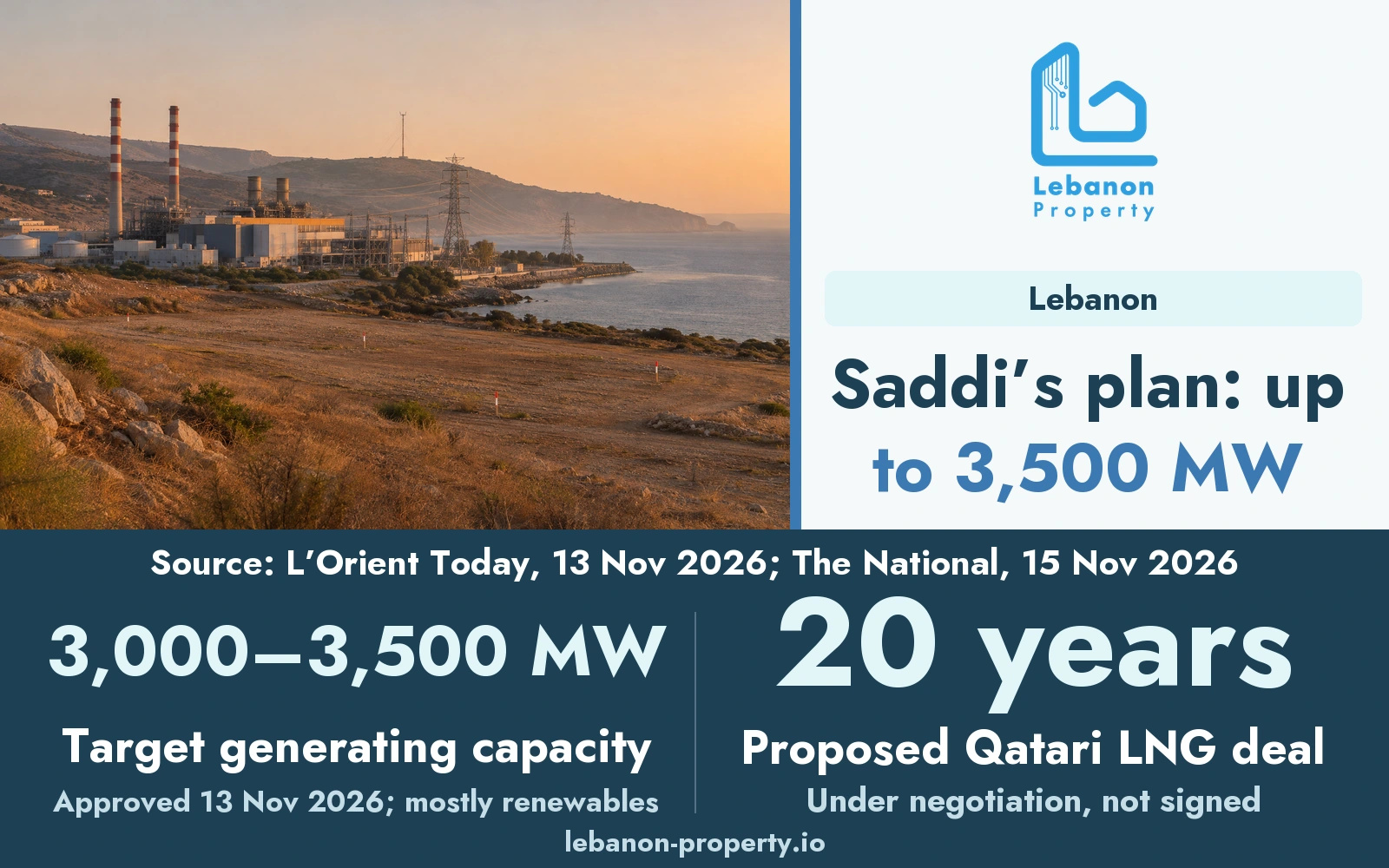
Lebanon’s cabinet approved Energy and Water Minister Joe Saddi’s electricity plan on Friday 13 November 2026, Information Minister Paul Morcos announced. The plan aims to raise generating capacity to between 3,000 and 3,500 megawatts, most of it from renewable sources, and tasks Saddi with continuing negotiations with Qatar. Two days later, Saddi and Prime Minister Nawaf Salam were in Doha discussing a proposed 20-year liquefied natural gas (LNG) supply deal. No agreement has been signed.
What the cabinet approved
After the session at the Grand Serail, Morcos set out four strands, as reported by L’Orient Today: gas, generation, transmission, and distribution with bill collection. In the short term, natural gas would be piped through the Arab Gas Pipeline to the Deir Ammar power station in the north, replacing the diesel it burns today and cutting production costs. Imported LNG would also supply the Deir Ammar, Zahrani and Zouk plants.
Over the longer term, the plan targets 3,000 to 3,500 MW of capacity, the majority expected from renewable sources. Private companies would join distribution and bill collection as distribution network operators, within a framework set by the Electricity Regulatory Authority. The approval came a day after Parliament, on 12 November, voted a supplementary appropriation in Lebanese pounds equivalent to $100 million, partly to settle sums that public bodies owe Électricité du Liban (EDL). Saddi said the money would allow more hours of supply, and that he would announce a Qatari agreement only once it is finalised.
L'Orient Today · 2026-11-13
In Doha: progress, but no signature
Salam and Saddi met Qatar’s Prime Minister and Foreign Minister, Sheikh Mohammed bin Abdulrahman Al Thani, in Doha on Sunday 15 November. According to Salam’s office, as reported by The National, the proposals include generating more electricity inside Lebanon, importing energy via Syria, a sea terminal to receive gas, a 20-year LNG supply agreement and renewable energy projects.
Salam spoke of significant progress towards a government-to-government agreement, and Lebanese energy officials stayed on for technical talks. The National reported no volumes, prices or signing date. Those are the details that will decide what the deal actually costs Lebanon and its electricity consumers.
The National · 2026-11-15
The scale of the reported Qatari package
The clearest figures so far come from a draft programme seen by Reuters in October and summarised by Oilprice.com on 19 October. It describes two 825 MW combined-cycle gas plants, at Deir Ammar in the north and Zahrani in the south, that could be built in about three years; a floating storage and regasification unit; and around 800 MW of solar and 440 MW of wind with battery storage. Salam said at the time that Qatar would finance, build and operate the project, with no upfront cost to the Lebanese state.
Two distinctions matter. Gas-fired plants are not renewable energy, even when they sit in the same package as solar and wind. And megawatts describe capacity, not delivered electricity: solar output follows sunshine hours, and batteries shift energy in time rather than generate it. The draft is a proposal, and payment obligations and guarantees were reported to be still open for negotiation.
Oilprice.com (citing Reuters) · 2026-10-19
What households and businesses should watch
On 17 November, Saddi briefed President Joseph Aoun on the Doha talks, MTV Lebanon reported, without giving new figures. The next public milestones are a signed agreement, its return to cabinet, and the tariff and guarantee terms behind it.
For homes, shops and offices that pay both an EDL bill and a private generator bill, the practical test is hours of state supply and the price per kilowatt-hour, not the megawatt target. Until contracts are signed and plants are built, the plan is a pipeline, not delivered power.
Related reading: Lebanon’s solar call: 350 MWp and 1,000 MWh are a pipeline, not delivered power.
MTV Lebanon · 2026-11-17
Prepared and reviewed 18 November 2026. Source dates and project stages are stated in the article; practical questions are editorial analysis.
Sources
- Electricity: The government approves Joe Saddi’s plan
L'Orient Today · Published: 2026-11-13 · Accessed: 2026-11-18
Cabinet session of 13 Nov 2026; Parliament sitting of 12 Nov 2026 · Lebanon
- Lebanon in talks for 20-year gas deal with Qatar
The National · Published: 2026-11-15 · Accessed: 2026-11-18
Doha visit of 15 Nov 2026 · Lebanon and Qatar
- Qatar Offers Lebanon 2 Gas Plants and 20 Years of LNG Piped Through Syria
Oilprice.com (citing Reuters) · Published: 2026-10-19 · Accessed: 2026-11-18
Draft programme dated October 2026 · Lebanon
- Energy Minister Saddi briefs President Aoun on Doha visit
MTV Lebanon · Published: 2026-11-17 · Accessed: 2026-11-18
17 Nov 2026 · Lebanon